


- Blog Post
- Tax, Live in Portugal
Long-Term Rental or Local Accommodation (AL) in Portugal? How to Tell the Difference
🏠 What Is a Lease (*Arrendamento*)?
A lease is a contract under the Civil Code in which the owner lets the tenant use the property as a home (or for another purpose) in exchange for rent.
- Purpose: permanent residence, or temporary residence for specific reasons (work, study, medical treatment) — the arrendamento para fins especiais transitórios
- Services: the landlord provides the property; no hotel-type services
- Formalities: written contract, registered with the tax authority, Stamp Duty, electronic rent receipts
- Tax: category F (25% or lower with incentives, or aggregated)
🧳 What Is Local Accommodation (AL)?
AL is a tourist accommodation service provided for a fee, to guests, in properties that don’t qualify as hotels.
- Purpose: temporary stays, typically for tourism
- Services: usually includes cleaning, bed linen, reception or check-in, and other services
- Formalities: registration with the municipality (RNAL number), compliance with safety and hygiene rules, insurance, complaints book, guest registration with the authorities
- Tax: category B (business income), VAT rules and opening an activity
🔍 The Key Differences
To decide which one you have, look at:
- Who the occupant is: a tourist or someone who lives there (even temporarily for work or study)
- Services provided: hotel-type services point to AL; just the property points to a lease
- Duration: nights or weeks point to AL; months or years point to a lease
- Contract: an accommodation booking vs a lease contract
- How it’s marketed: on booking platforms to tourists vs on rental platforms for residents
There’s no single fixed number of days in the law — what counts is the overall nature of the arrangement.
🎓 The Grey Areas
- Students for a semester: usually a lease for temporary purposes (study), with a written contract registered with the tax authority
- Digital nomads for 1–6 months: can be either — a temporary lease if it’s their residence during their stay (with a contract and without hotel services), or AL if it’s sold as accommodation with services
- Rooms in a shared house: a room lease if the tenants live there; AL if offered to guests for short stays with services
- Switching between both: possible, but each period must follow its own rules and the AL registration must be in place
💶 Tax Comparison
Lease (category F):
- Net income (rents minus expenses) taxed at 25%, or 15%, 10%, 5% for long leases (with further reductions for renewals), or 10% from 2026 to 2029 for residential leases with a moderate rent of up to €2,300 per month (Decree-Law 97/2026)
- No VAT, no Social Security
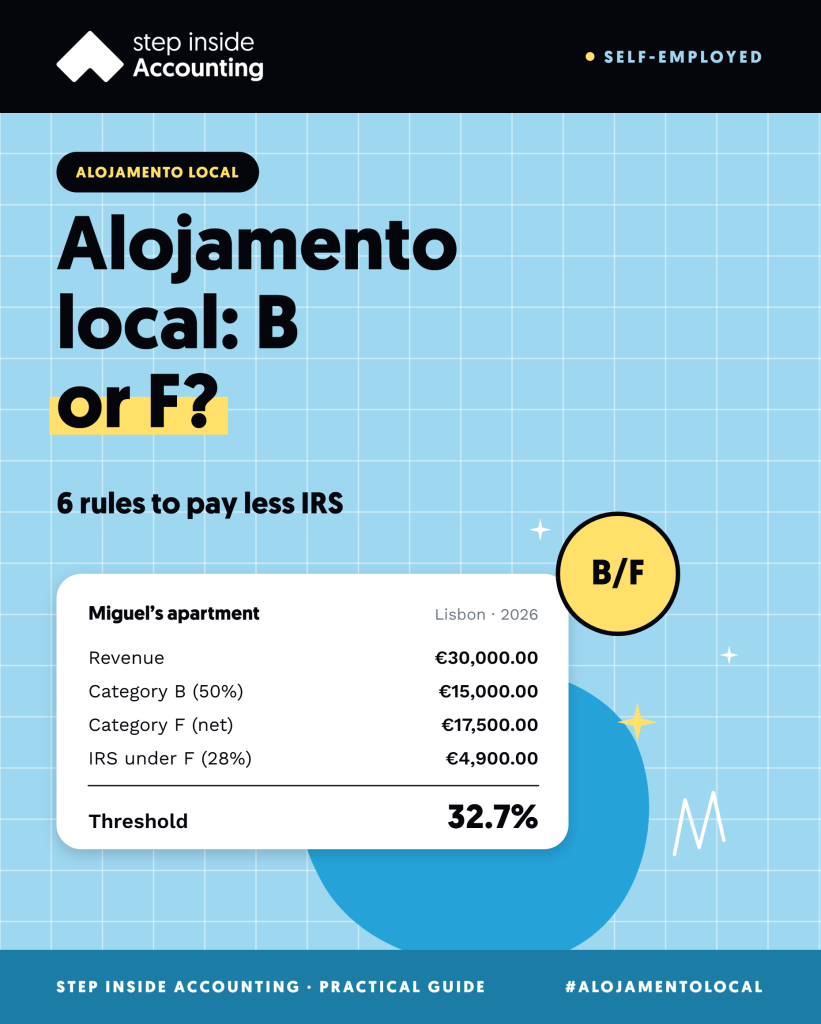
AL (category B, simplified regime):
- 35% of income taxable at progressive rates for apartments and houses (50% in areas under housing pressure)
- Option to be taxed under category F rules
- VAT may apply (exempt below €15,000 turnover), plus tourist tax where the municipality charges it
- Social Security contributions may be due
⚠️ Risks of Getting It Wrong
- Running AL without registration: heavy fines and possible closure
- Calling an AL a “lease” to avoid registration: the authorities look at the reality, not the label
- Declaring AL income as category F without exercising the option correctly
- Short leases without a valid reason for a temporary purpose may be questioned
💡 Practical Tips
- Offering services and short stays? Register as AL.
- Renting to someone who lives there? Sign a lease, even if temporary, and register it.
- Temporary lease? State the purpose (work, study) in the contract.
- Check local rules — several municipalities limit new AL registrations.
🚀 Final Considerations
The line between a lease and local accommodation depends on who stays, for how long and what you provide. Choosing the right model — and following its rules — protects you from fines and lets you use the most favourable tax treatment.
📢 Expert Advice: For medium-term stays, document the purpose of the stay and keep the arrangement consistent: a lease without hotel services, or AL with a registration. Mixing both is where problems start.
Not sure which model fits your property? Step Inside Portugal’s tax team can analyse your situation and help you comply — find out more about our tax services here. ✨
This article is for general information only and doesn’t constitute tax or legal advice. Local rules on AL vary by municipality.
Save PDF version for later
Share it with friends
Want to learn more? Explore our other resources...

- Blog Post
- Tax, Live in Portugal
- Blog Post
- Step Inside Accounting, Company
- Blog Post
- Step Inside Accounting, Self-Employee