

- Blog Post
- Immigration, Live in Portugal
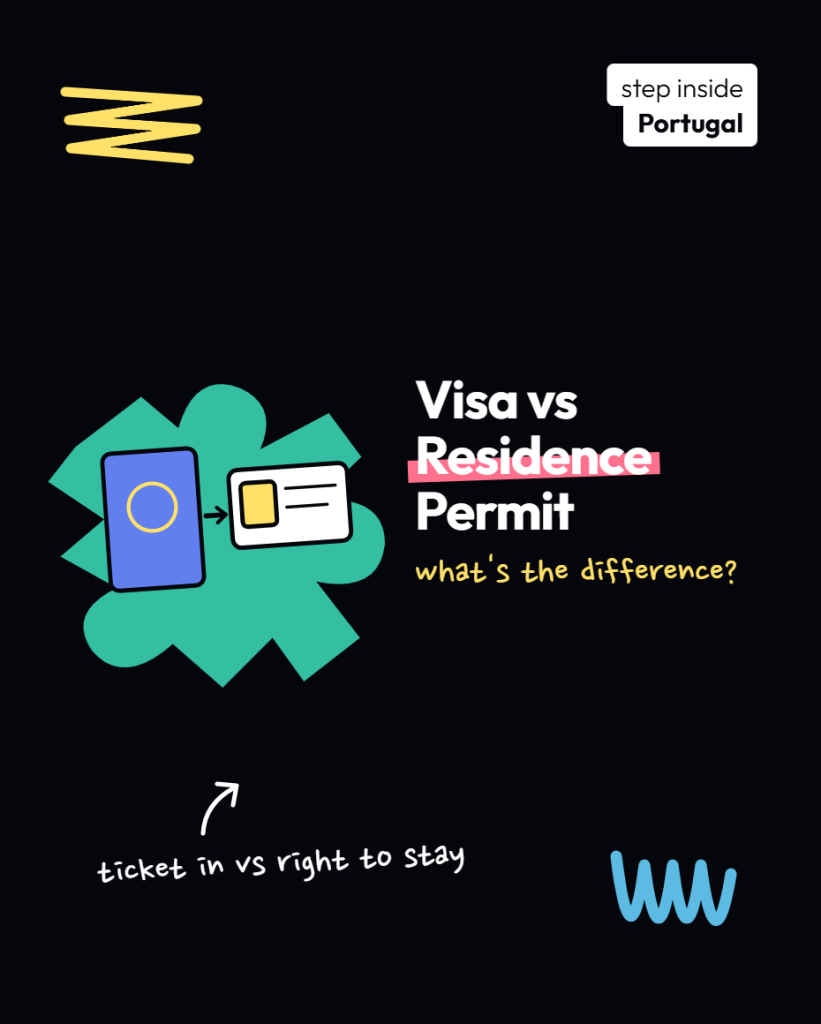
Visa vs Residence Permit in Portugal: What’s the Difference?
🛂 What Is a Visa?
A visa is an authorisation to enter Portugal (and the Schengen area) for a specific purpose.
- It’s issued before you travel, by the Portuguese consulate or embassy in your country of residence.
- It’s a sticker in your passport.
- It’s temporary:
- Short-stay (Schengen) visa: up to 90 days in any 180-day period
- Temporary stay visa: for stays of less than one year
- Residence visa (D visa): valid for four months, with two entries, so you can travel to Portugal and apply for your residence permit
In short: the visa is your ticket in.
🪪 What Is a Residence Permit?
A residence permit (autorização de residência) is an authorisation to live in Portugal.
- It’s issued after you arrive, by AIMA (Agência para a Integração, Migrações e Asilo).
- It’s a card (título de residência).
- It’s valid for longer periods:
- Temporary residence permit: usually two years, then renewed for three years
- Permanent residence permit: after five years
In short: the residence permit is your right to stay.
⚖️ The Key Differences
- Purpose: the visa lets you enter; the residence permit lets you live in Portugal.
- Who issues it: the visa comes from the consulate (Ministry of Foreign Affairs); the residence permit from AIMA.
- Where you apply: the visa abroad; the residence permit in Portugal.
- Format: the visa is a passport sticker; the residence permit is a card.
- Duration: the residence visa lasts four months; the residence permit lasts years and can be renewed.
🛤️ How They Work Together
For most people moving from outside the EU, the journey looks like this:
- Apply for a residence visa at the consulate (D1, D2, D3, D4, D7, D8…).
- Travel to Portugal within the visa’s four-month validity.
- Attend your AIMA appointment and apply for the residence permit.
- Receive your residence card and live in Portugal legally.
- Renew your permit and, after five years, apply for permanent residence.
🔓 Can You Get a Residence Permit Without a Visa?
Since the 2025 reform, the general rule is clear: you need the right visa before moving. The old route of entering as a tourist and applying for residence later (manifestação de interesse) no longer exists.
There are still a few specific exceptions, such as:
- Highly qualified activity, for people who entered and stayed in Portugal legally
- Family members of EU or Portuguese citizens, under their own regime
- Golden Visa (residence permit for investment), applied for online
- Certain cases of family reunification for family members already legally in Portugal
🇪🇺 And EU Citizens?
EU, EEA and Swiss citizens don’t need either. They simply register with the Câmara Municipal and get a CRUE if they stay longer than three months.
⚠️ Common Mistakes
- Thinking a Schengen visa allows you to live in Portugal — it doesn’t.
- Letting the residence visa expire before your AIMA appointment without a solution.
- Travelling with only the AIMA receipt — it’s generally not a travel document.
- Assuming you can “fix it later” in Portugal — since 2025, that’s rarely possible.
🚀 Final Considerations
The visa opens the door; the residence permit lets you stay. Planning both steps together — and choosing the right visa from the start — is the key to a smooth move.
📢 Expert Advice: Choose your visa with the residence permit in mind. The conditions you show at the consulate are the ones you’ll need to keep meeting at AIMA and at every renewal.
Planning your move to Portugal? Step Inside Portugal can guide you through both steps, from the consulate to AIMA — find out more about our immigration services here. ✨
This article is for general information only and doesn’t constitute legal advice. It reflects the rules as of October 2026; confirm the requirements that apply to your case.
Save PDF version for later
Share it with friends
Want to learn more? Explore our other resources...
- Blog Post
- Immigration, Live in Portugal
- Blog Post
- Immigration, Live in Portugal
- Blog Post
- Immigration, Live in Portugal
Lorem ipsum dolor sit amet, consectetur adipiscing elit. Ut elit tellus, luctus nec ullamcorper mattis, pulvinar dapibus leo.