IRC payments on account: 5 rules so July, September and December don’t catch you out

Every year, in July, September and December, many companies receive a corporate tax (IRC) bill halfway through the year. These are payments on account: advances on the current year’s tax, based on the previous year. Knowing how they work avoids cash-flow scares and overpaying.

Step Inside Accounting · Practical guide

#StepInsideAccounting

1. They are an advance on this year’s IRC

Payments on account (pagamentos por conta) are three corporate tax (IRC) payments made during the year, on account of the tax the company will work out the following year in its annual return (Modelo 22). They are not a new tax: it is the same IRC, paid earlier.

They apply to companies that had IRC to pay in the previous year. There are no payments on account in the first year of activity, nor when the previous year’s IRC, after deducting withholding tax, was below €200.

2. How they are calculated

The starting point is the previous year’s IRC, minus any withholding tax the company suffered. A percentage is applied to that amount, depending on the previous year’s turnover:

  • 80% if turnover was up to €500,000.
  • 95% if it was above €500,000.

The result is split into three equal payments, rounded up to the euro.

Example

In 2025, the company invoiced €180,000 and its IRC was €3,000, with no withholding tax. In 2026 it pays 80% of €3,000, that is €2,400, in three payments of €800.

3. The dates: July, September and 15 December

For companies whose tax year matches the calendar year, the payments are due in July, in September and by 15 December. They are paid with a payment slip issued on the Tax Authority’s portal (Portal das Finanças), in the IRC advance payments area. Your accountant usually prepares the slip.

Since the amounts are known as soon as the annual return is filed in May, there is no reason for surprises: set the money aside at that point.

4. The 3rd payment can be reduced or skipped

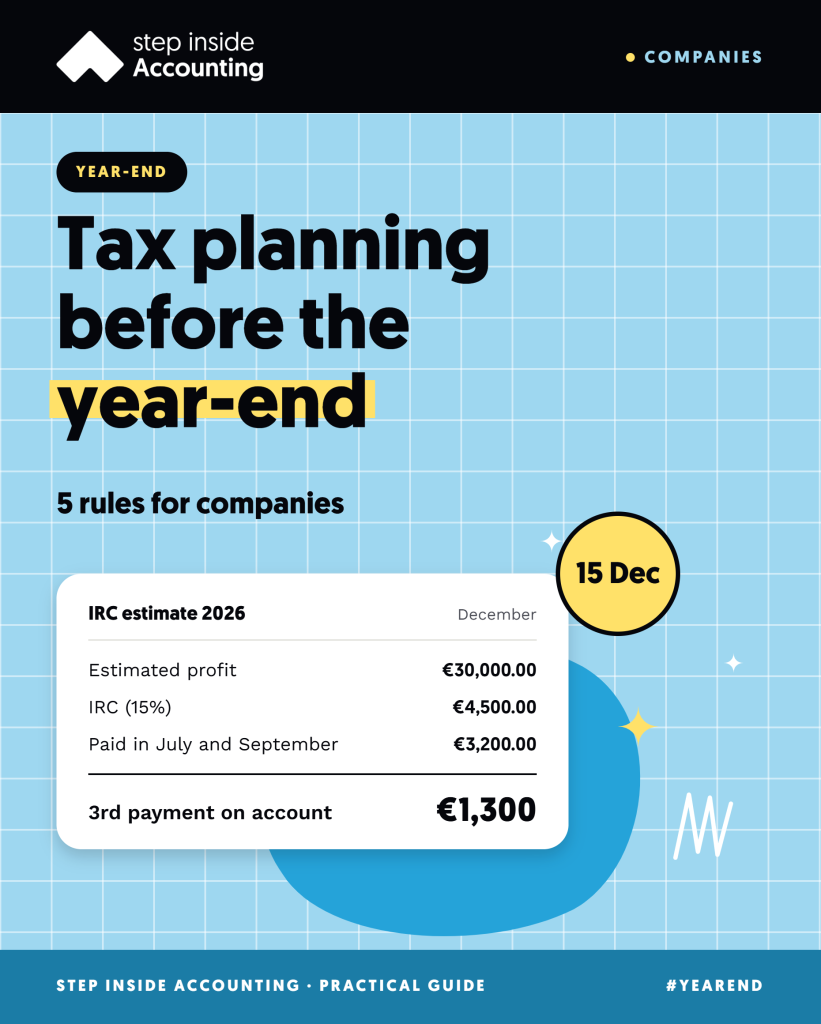
If the year is going worse than the previous one, the company can limit the 3rd payment to what is still missing for the tax it expects to pay, or skip it if the payments already made are enough. The first two payments cannot be reduced.

The decision must be based on a realistic estimate of the profit. If it later turns out that more than 20% of what would normally have been paid was left unpaid, compensatory interest is charged.

Example

The company in the previous example has already paid €1,600 in July and September. In November, the estimate points to €1,500 of IRC for 2026. As it has already paid more than that, it can skip the 3rd payment of €800.

5. The balance is settled in the annual return

When it files the year’s IRC return, the company compares the final tax with the payments on account. If it paid too little, it pays the difference; if it paid too much, it gets a refund.

Missing a payment on account can lead to a fine and interest. When there is no tax to pay at the end of the year, the courts have set the fine aside, but that is not automatic.

Team tip

In November, work out an estimate of the year’s profit with us. That is what tells you whether to make the 3rd payment on account in full or keep that money in the company.

Want us to handle this for you?

Companies

Monthly accounting

Bookkeeping, tax obligations and managing partners’ salaries, all in one place.

€250 + VAT / month

business@stepinsideaccounting.com

Self-employed

Recibos verdes without the stress

Tax returns, VAT and Social Security handled by people who know the regime inside out.

from €80 + VAT / month

self-employee@stepinsideaccounting.com


This article is for information only and does not replace professional advice. Figures and rules are those in force at the date of publication and may change.

Explore more resources
Share with someone who needs it

Want to know more? Explore the other Step Inside Accounting resources

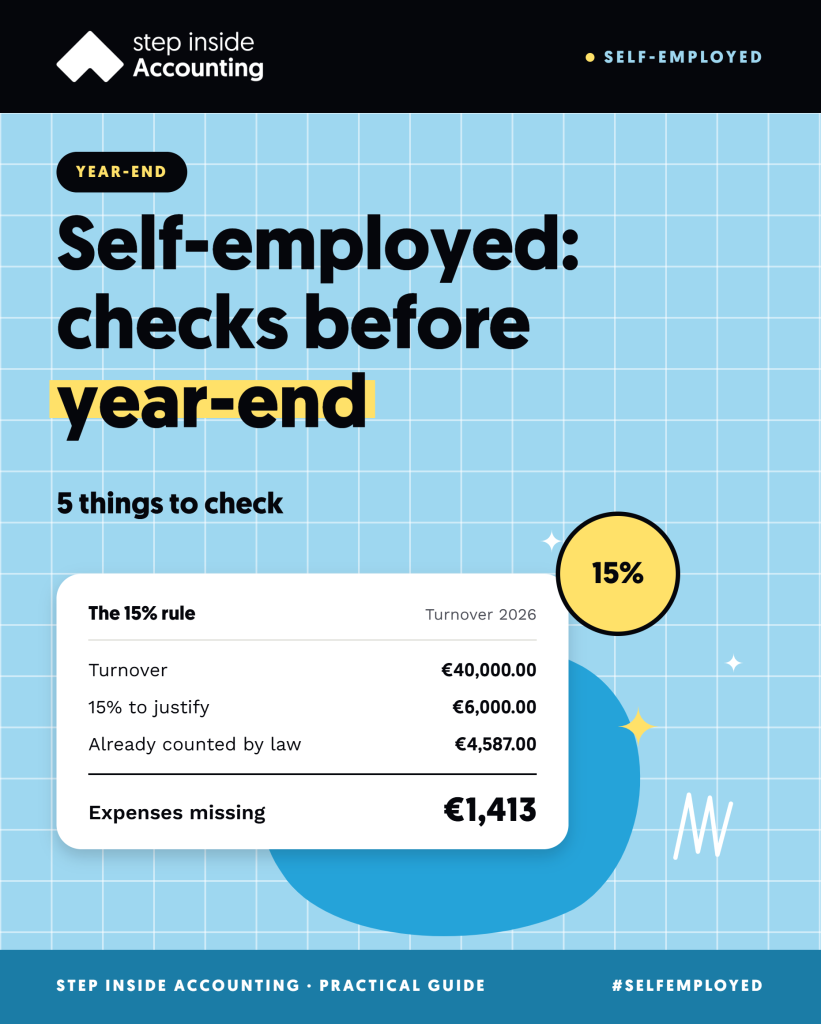
If you work on recibos verdes under the simplified regime, December is the time to review your expenses, VAT and Social Security. An hour of review now avoids paying too much income tax in 2027 and surprises in January.
December is the last month in which you can still shape the year’s tax result. With a profit estimate in hand, the company can decide on purchases, adjust the last payment on account and prepare for 2027 with no surprises.
Many of our clients have a company in Portugal and live in another country, or move abroad after setting it up. The company keeps running normally, but there are specific rules for notifications, dividends, the manager’s salary and even the