Investments Linked to Tax Havens: Why Portugal Taxes Them at 35%

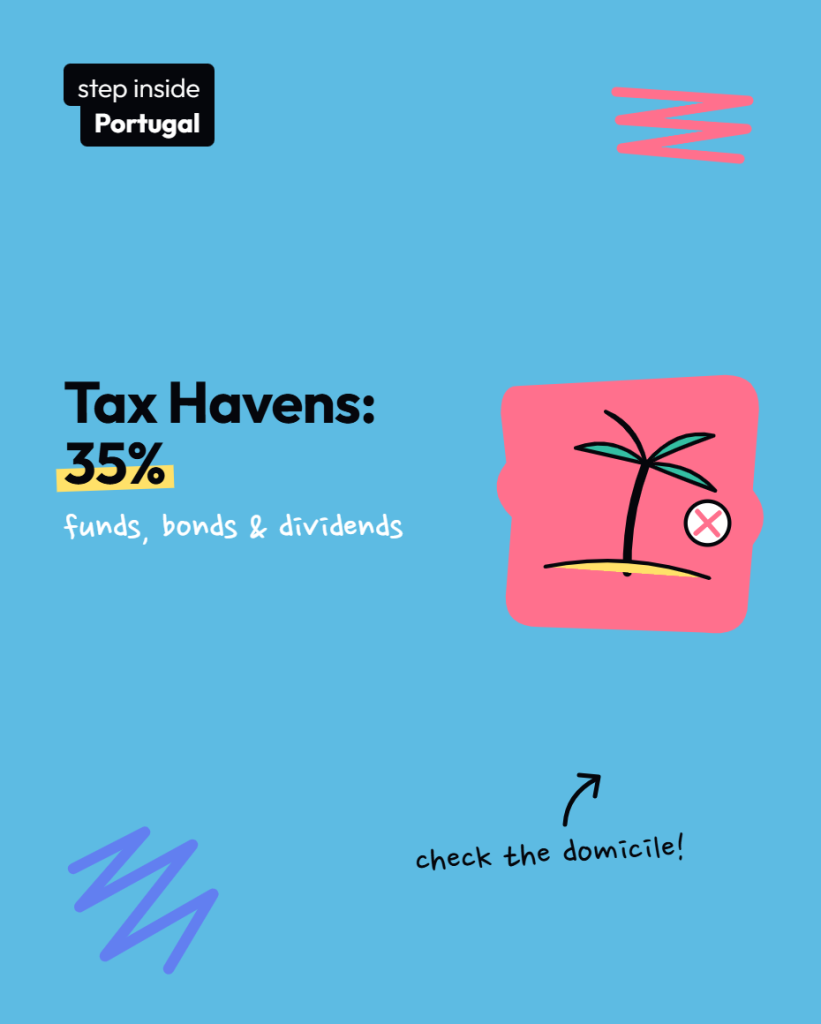
Portugal taxes most investment income and gains at 28%. But when the income comes from entities in a tax haven — a jurisdiction on Portugal’s list of countries with clearly more favourable tax regimes — the rate rises to 35%, and other restrictions apply. If you hold funds, bonds or shares linked to these jurisdictions, here’s what you need to know.
🏝️ What Is a Tax Haven for Portugal?

Portugal publishes a list of jurisdictions with clearly more favourable tax regimes (the “blacklist”), approved by ministerial order. It’s updated from time to time — for example, the 2025 update removed Hong Kong, Liechtenstein and Uruguay from 2026.

See our article on Portugal’s tax haven list for details.

💶 What Is Taxed at 35%? (Article 72)

  • Capital income (interest, dividends and other category E income) paid or made available by entities resident in tax havens
  • Gains on the redemption or liquidation of units in investment funds domiciled in tax havens
  • Capital income paid into accounts held on behalf of unidentified third parties

These are taxed at 35% instead of 28%.

📈 What About Bonds and Shares?

  • Interest on bonds issued by entities in tax havens is capital income — taxed at 35%
  • Dividends from companies in tax havens — taxed at 35%
  • Gains on selling shares or bonds of tax-haven entities are category G income; Article 72(18) applies the 35% rate to the net gains from certain operations on securities issued by these entities (such as redemptions and liquidations), and to gains linked to trusts and similar structures domiciled there — and in any case, losses with tax-haven counterparties can’t be deducted

🚫 Other Consequences

  • No 50% reduction on dividends when aggregated
  • Losses not deductible in operations with entities in tax havens
  • No exemption under IFICI or NHR for income from tax havens
  • Longer audit period: the tax authority can assess tax for up to 12 years
  • Stricter reporting requirements, including for accounts and assets abroad

🔍 How to Check Your Investments

  • Check the domicile of each fund (for example, Cayman Islands funds are common in alternative investments)
  • Check the issuer of bonds and structured products
  • Look at holding structures — companies in tax havens holding your investments
  • Review annually — the list changes

💡 Practical Tips

  • Prefer EU-domiciled funds (such as UCITS in Ireland or Luxembourg) where possible.
  • Review offshore structures before becoming a Portuguese resident.
  • Check the list every year, especially if you invest in alternative or private funds.

🚀 Final Considerations

Investments linked to tax havens are expensive in Portugal: 35% instead of 28%, no deduction of losses and no special regime exemptions. A quick check of where your funds and issuers are domiciled can avoid a costly surprise.

📢 Expert Advice: Before moving to Portugal, review the domicile of every fund and structure you hold. Restructuring before you become resident is usually much simpler.

Holding investments abroad? Step Inside Portugal’s tax team can review your portfolio’s tax treatment in Portugal — find out more about our tax services here. ✨


This article is for general information only and doesn’t constitute tax or investment advice. The list of tax havens changes over time.

Save PDF version for later
Share it with friends

Want to learn more? Explore our other resources...

Selling a property to your own company? Transferring shares to a family member's business? When an individual sells assets to a related party, the price can't simply be whatever suits the parties. Since 2024, Article 43(11) of the IRS Code
Portugal taxes most investment income and gains at 28%. But when the income comes from entities in a tax haven — a jurisdiction on Portugal's list of countries with clearly more favourable tax regimes — the rate rises to 35%,
Receiving dividends from shares or from your own company? In Portugal, dividends are capital income (category E), taxed by default at a flat 28%. But if you choose to aggregate them with your other income, dividends from Portuguese and EU

Lorem ipsum dolor sit amet, consectetur adipiscing elit. Ut elit tellus, luctus nec ullamcorper mattis, pulvinar dapibus leo.

Leave a Reply

Your email address will not be published. Required fields are marked *