Quarterly VAT with no surprises: 5 rules to have the money ready when the return is due
Blog Post
Step Inside Accounting, Company
Quarterly VAT with no surprises: 5 rules to have the money ready when the return is due
The VAT you charge your clients is not company revenue: it is money the company holds on behalf of the State until the return. If you spend it during the quarter, you reach the payment deadline with a bill that is hard to pay.
When you invoice €1,000 + €230 of VAT (IVA), the €230 does not belong to the company. It belongs to the State, minus the VAT the company paid on its own purchases.
The most common mistake is to look at the bank balance and think it is all available. Part of that money is already spoken for: the next VAT return.
2. Know when you pay
Companies with turnover below €650,000 in the previous year are, as a rule, on the quarterly scheme. The return is filed by the 20th of the second month after the quarter, and payment is due by the 25th of that month:
Q1 (January to March): May.
Q2 (April to June): September.
Q3 (July to September): November.
Q4 (October to December): February of the following year.
Note: VAT is due when you issue the invoice, even if the client has not paid you yet.
3. Keep the VAT in a separate account
Every time a client pays, move the VAT part to a separate company bank account. At the end of the quarter, the money is there and there are no surprises.
If there is VAT on purchases to deduct, the amount to pay will be lower, and whatever is left in the account goes back to the company’s cash after the return.
Example
In the quarter, the company invoiced €15,000 + €3,450 of VAT and paid €600 of VAT on purchases. The VAT to pay is €2,850. If it moved the VAT from each payment received to the separate account, it has €3,450 set aside: it pays the return and still has €600 left.
4. VAT on purchases counts too
The VAT on purchase invoices in the company’s name reduces the VAT to pay, but only if the invoices are complete and the VAT is deductible. Meals, accommodation and fuel for some cars, for example, have their own rules (see the articles on deductible expenses and VAT on cars).
Check every month on e-Fatura that purchase invoices are in the company’s name, and send your accountant any that are missing, especially from foreign suppliers.
5. If the amount is high, talk to us before the deadline
Filing the return late and paying late are two different failures, each with its own fine, and late payment also carries interest. Even if you cannot pay everything, always file the return on time.
If the quarter ends with more VAT to deduct than to pay, the company has VAT to recover, which it can carry forward to the next quarter or claim as a refund (see the article on VAT refunds).
Team tip
Open an account just for VAT and move the VAT on each invoice there on the day the client pays. It is the simplest way never to have to choose between paying the VAT and paying everything else.
Want us to handle this for you?
Companies
Monthly accounting
Bookkeeping, tax obligations and managing partners’ salaries, all in one place.
This article is for information only and does not replace professional advice. Figures and rules are those in force at the date of publication and may change.
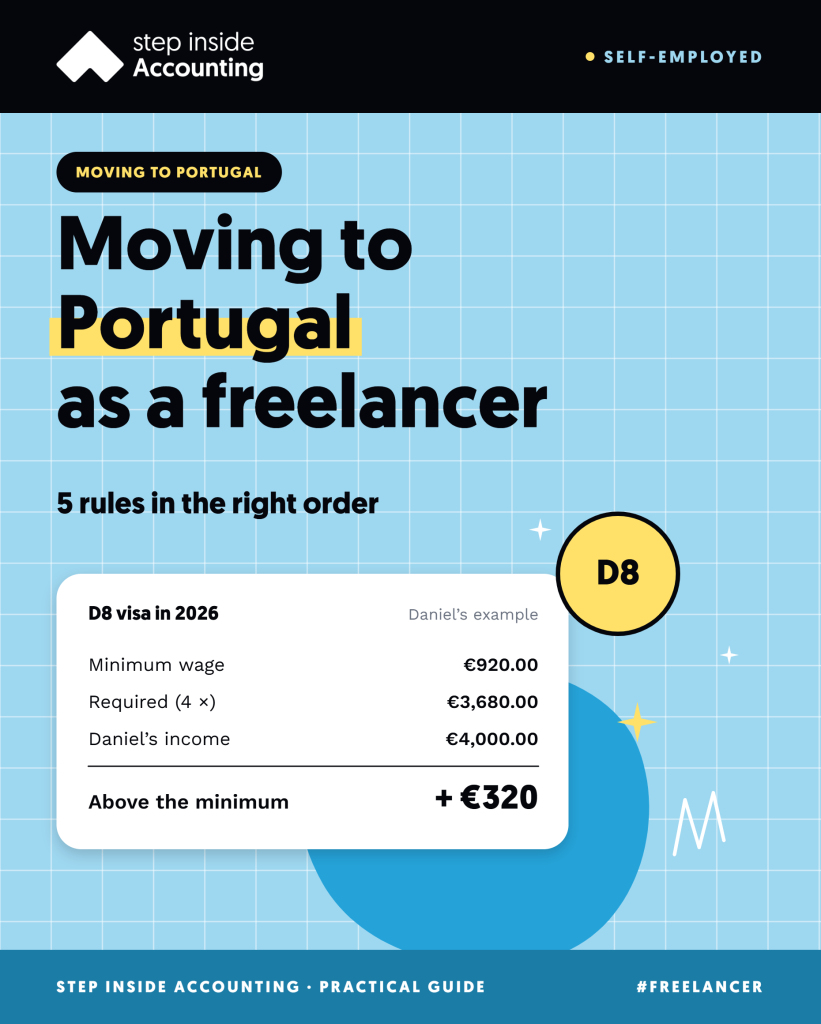
NIF, visa, bank account, NISS, opening activity, tax residence: if you are moving to Portugal to work for yourself, there is a lot to sort out, and many steps depend on each other. These are the five rules to avoid
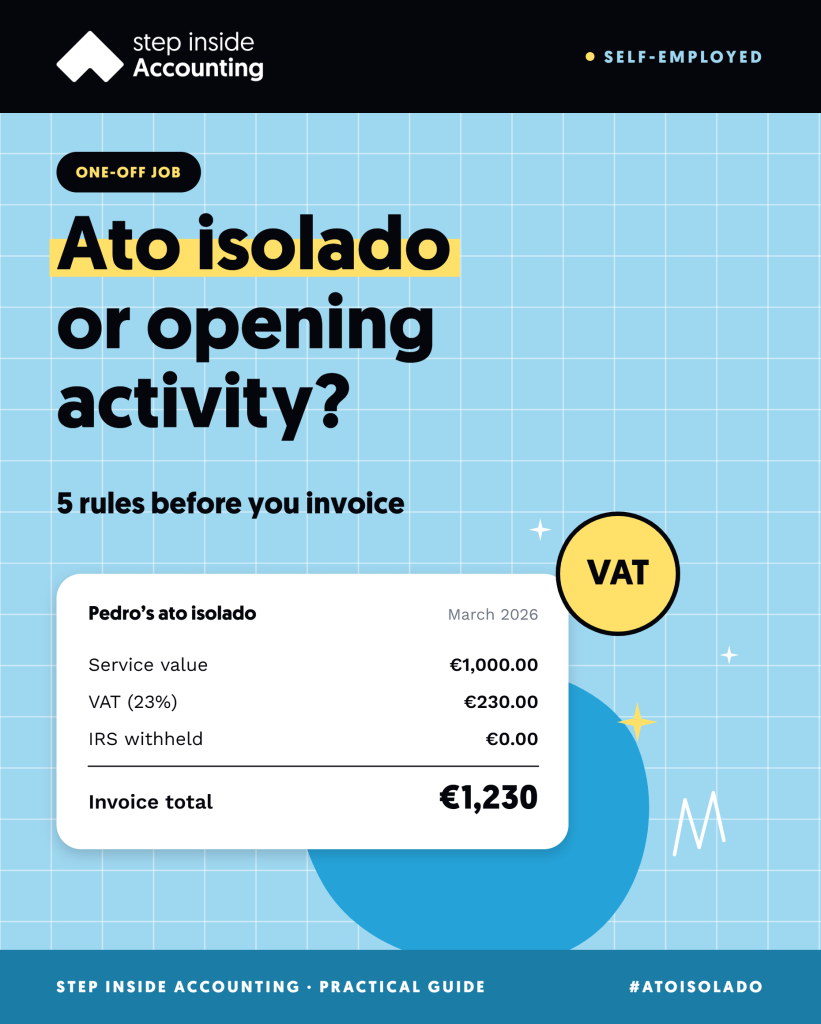
If you are asked to do a one-off job and do not have an open activity, the ato isolado (one-off act) lets you invoice it without registering as self-employed. But it only works for an occasional transaction, and the VAT,
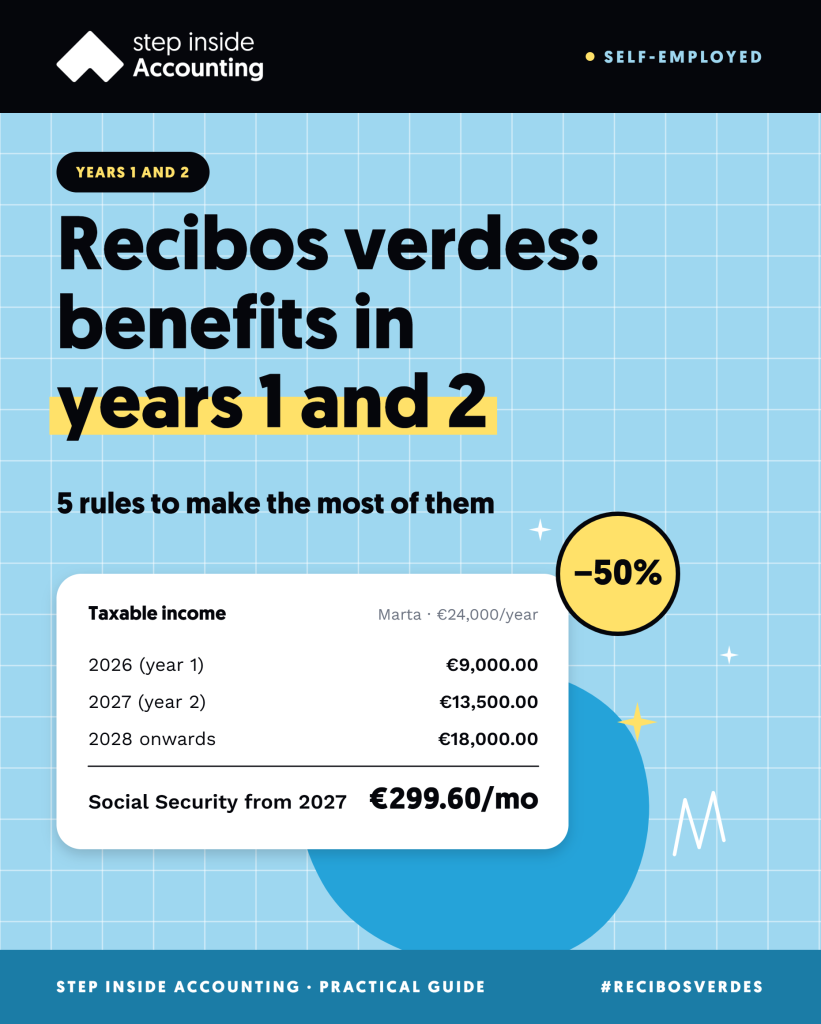
When you start out as self-employed, you pay less at first: no Social Security for a year, reduced IRS for two tax years and, in many cases, no VAT to charge. But each benefit has conditions and an end date,