


- Blog Post
- Step Inside Accounting, Self-Employee
First and second year on recibos verdes: 5 rules to make the most of the benefits (and prepare for when they end)
Step Inside Accounting · Practical guide
#StepInsideAccounting
1. Social Security: 12 months without contributions
If it is your first activity as self-employed, you pay no contributions for the first 12 months. Even so, you still file the quarterly income declaration – the exemption does not release you from that obligation.
When the exemption ends, you pay 21.4% on your relevant income, which is 70% of the value of the services you provide (20% for sales). In practice, that comes to about 15% of what you invoice for services. If you are also employed, you can stay exempt after the first year, as long as your self-employed income stays below four times the IAS per month, your clients are not your employer and your salary is at least equal to the IAS. The IAS (indexante dos apoios sociais, the social support index) is the reference amount the State uses to calculate benefits and limits: in 2026 it is €537.13, so four times the IAS is €2,148.52 a month.
2. IRS: you only pay on half in year 1
Under the simplified regime, IRS is charged on 75% of what you invoice for activities in the CIRS table and on 35% for other services. In the year you open activity, those percentages are reduced by 50%; in the following year, by 25%.
In practice:
- activities in the CIRS table: 37.5% in year 1, 56.25% in year 2 and 75% from year 3;
- other services: 17.5% in year 1, 26.25% in year 2 and 35% from year 3.
Note: “year 1” is the calendar year in which you open activity. If you start in November, the 50% reduction only applies to two months of invoicing.
3. Know what makes you lose the IRS reduction
The reduction is not automatic for everyone. You lose the benefit for that year if:
- you have employment income, even just one month’s salary;
- you receive pensions;
- you closed a self-employed activity in the previous 5 years.
It also only applies to services: people who sell goods do not get this reduction. If you left a job in March and opened activity in April, you no longer get the reduction that year – it may be worth talking to us before you choose the date.
4. VAT: exempt while you stay below €15,000
If you invoice up to €15,000 a year in services located in Portugal, you may not need to charge VAT. This benefit is not exclusive to the start – it lasts as long as you stay below the limit – but it matters most in the first years, because it makes you cheaper for private clients.
In the year you open activity, the limit is calculated as if you worked the whole year. And if you go over €15,000, you must report the change to the Tax Authority and start charging VAT. Track your invoicing month by month, especially as you get close to the limit.
5. Plan for the end of the benefits from the first month
In year 3, three increases come together: you pay Social Security all year, IRS is charged on the full percentage and your IRS refund tends to shrink. Anyone who has not prepared feels the difference all at once.
What we recommend:
- set aside every month the Social Security amount you will pay when the exemption ends;
- do not count on your year-1 IRS refund as income – it will be smaller in the following years;
- review your prices at the end of year 1, with the full costs included;
- before accepting an employment contract, check the impact on your IRS reduction.
Example
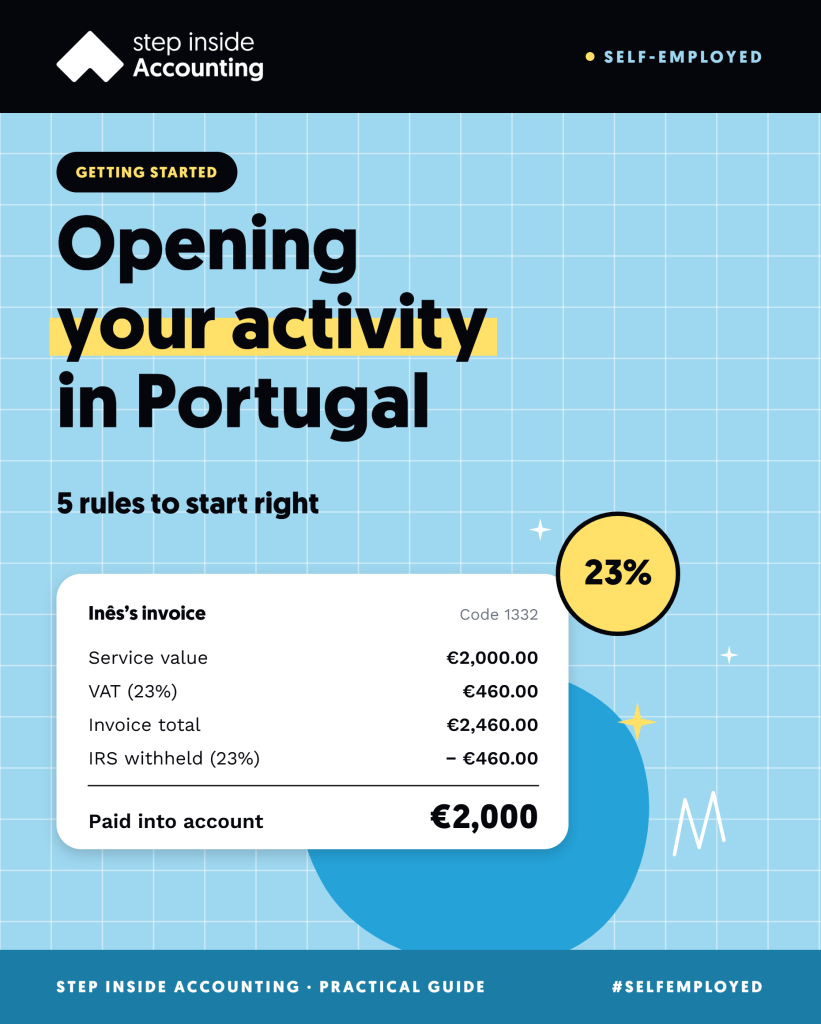
Marta is a programmer (code 1332), opens activity in January 2026 and invoices €2,000 a month – €24,000 a year – to Portuguese companies. She has no other income. Under the current rules:
- 2026 (year 1): taxable income for IRS of €9,000 (€24,000 × 37.5%); Social Security: €0.
- 2027 (year 2): taxable income of €13,500 (€24,000 × 56.25%); Social Security: €299.60 a month (€2,000 × 70% × 21.4%).
- 2028 onwards: taxable income of €18,000 (€24,000 × 75%); Social Security: €299.60 a month.
In two years, the income on which she pays IRS doubles and she starts paying about €3,595 a year to Social Security. As she invoices more than €15,000, Marta charges VAT from the start: the exemption does not apply to her.
Team tip
During the exemption period, move the amount you will pay in Social Security into a separate account every month (in Marta’s case, about €300). When the exemption ends, the cost is already in your budget. And if you are offered an employment contract in year 1 or 2, talk to us before you sign: a single month’s salary can cost you that year’s IRS reduction.
Want us to handle this for you?
Companies
Monthly accounting
Bookkeeping, tax obligations and managing partners’ salaries, all in one place.
€250 + VAT / month
Self-employed
Recibos verdes without the stress
Tax returns, VAT and Social Security handled by people who know the regime inside out.
from €80 + VAT / month
This article is for information only and does not replace professional advice. Figures and rules are those in force at the date of publication and may change.
Explore more resources
Share with someone who needs it
Want to know more? Explore the other Step Inside Accounting resources
- Blog Post
- Step Inside Accounting, Self-Employee
- Blog Post
- Step Inside Accounting, Self-Employee
- Blog Post
- Step Inside Accounting, Self-Employee