


- Blog Post
- Step Inside Accounting, Self-Employee
Alojamento local and IRS: 5 rules to know how much tax you pay on what you receive
Step Inside Accounting · Practical guide
#StepInsideAccounting
1. Alojamento local is an activity – and the income is self-employed income
To run an alojamento local you need the registration with the town council and to open an activity with the Tax Authority. From then on, what you receive from guests is business income – the same category as recibos verdes – and goes into your IRS return, in the self-employed annex.
What counts is the full amount paid by guests, including what goes through the platforms. Platform commissions are an expense; they do not reduce your income. Amounts from cancelled bookings that you do not refund are also income.
2. Under the simplified regime, the coefficient depends on the type of accommodation and the area
Most alojamentos locais are under the simplified regime, in which only part of what you receive is taxed:
- house or apartment: 35% (coefficient 0.35);
- house or apartment in a containment area defined by the town council: 50% (coefficient 0.50);
- rooms and guest houses (hostels): 15% (coefficient 0.15).
For a house or apartment outside containment areas, the 15% rule also applies. A specific rule helps here: 4% of the property’s tax value counts as an expense. The result is added to your other income and taxed at the normal IRS rates.
3. You can choose to be taxed as if it were rent
If the alojamento local is a house or an apartment, you can choose, every year, in your IRS return, to be taxed under the rules for property income (the rules for rents). In that case:
- you pay on your income minus the expenses actually paid during the year: platform commissions, cleaning, condominium fees, IMI, repair and maintenance work, insurance. Mortgage interest, furniture, appliances and decoration do not count;
- only expenses with invoices count;
- the result is taxed at 28%, or at the normal rates if you choose to aggregate it.
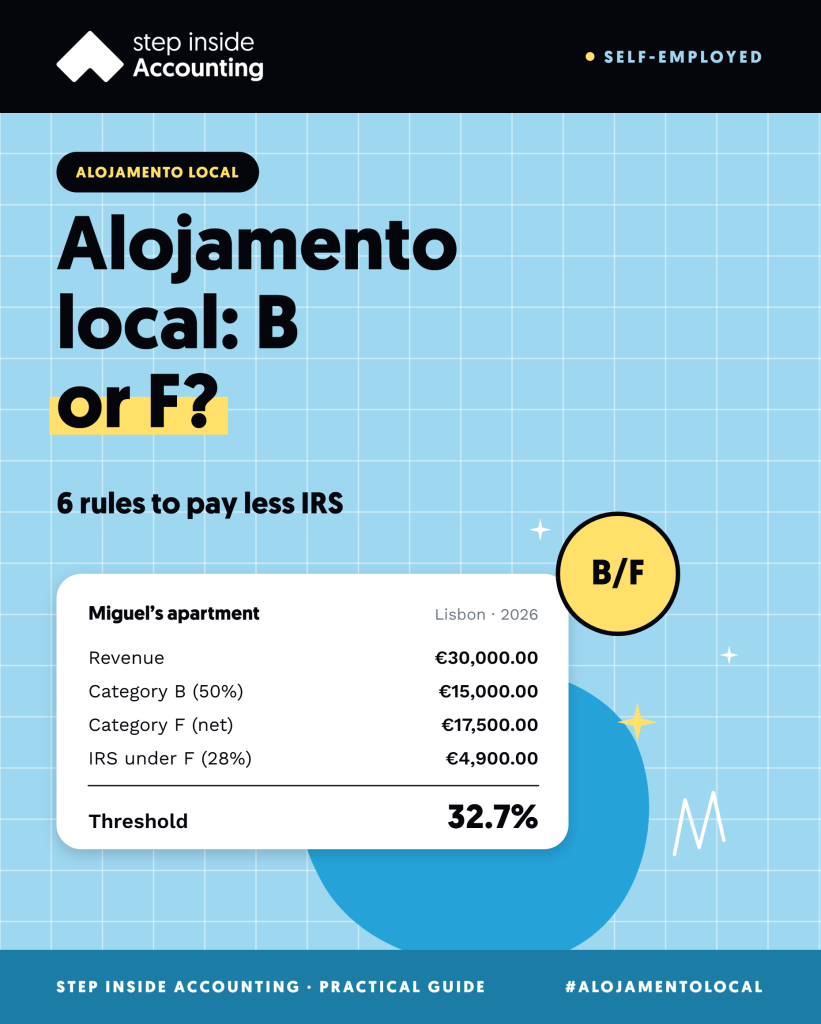
This option may pay off when expenses are very high and your IRS rate is high. In most cases, the simplified regime results in less tax. Do both calculations every year before you file your return – we explain how in our article on category B or category F.
4. Above €200,000, or by choice, there is organised accounting
If you have several properties and invoice more than €200,000 a year, you must move to organised accounting. You can also choose it earlier. Then you pay on your real profit: income minus all expenses, including the wear and tear of the property and its contents and the mortgage interest. We compare the two regimes in our article on the simplified regime and organised accounting.
5. Do not forget VAT and Social Security
IRS is not the only tax on alojamento local:
- VAT: up to €15,000 a year you are exempt. Above that, you charge VAT at the reduced rate for accommodation, 6% on the mainland;
- Social Security: if alojamento local in a house or apartment is your only self-employed income, you are excluded from the self-employed scheme and do not pay contributions. If you also issue recibos verdes, or if you run rooms or a hostel, the rules are different – talk to us;
- tourist tax: in the municipalities that charge it, you collect it from guests and pay it to the town council. It is not your income.
Example
Carla has an apartment in alojamento local outside containment areas. In 2026, her guests pay €14,000. As this is below €15,000, she does not charge VAT. Her expenses for the year are €5,500: platform commissions (€2,100), cleaning (€1,800), condominium fees (€600), utilities (€600) and IMI (€400).
- Simplified regime: taxable income of €4,900 (35% of €14,000), added to her other income. The 15% rule is met: 15% of €14,000 is €2,100, less than the fixed deduction.
- Option for the rent rules: income of €8,500 (€14,000 − €5,500), taxed at 28%, that is, €2,380 of IRS.
Carla is taxed on €4,900 in one case and €8,500 in the other. For the simplified regime to mean more tax than the €2,380 of the other option, her IRS rate would have to exceed 48.6% (€2,380 ÷ €4,900), which only happens at very high incomes. For Carla, the simplified regime is clearly better.
Team tip
Before you open your activity, check with the town council whether the property is in a containment area: that changes the coefficient from 0.35 to 0.50. Keep all the alojamento local invoices in your NIF, even under the simplified regime: they are what allow you to compare the two options every year.
Want us to handle this for you?
Companies
Monthly accounting
Bookkeeping, tax obligations and managing partners’ salaries, all in one place.
€250 + VAT / month
Self-employed
Recibos verdes without the stress
Tax returns, VAT and Social Security handled by people who know the regime inside out.
from €80 + VAT / month
This article is for information only and does not replace professional advice. Figures and rules are those in force at the date of publication and may change.
Explore more resources
Share with someone who needs it
Want to know more? Explore the other Step Inside Accounting resources
- Blog Post
- Step Inside Accounting, Company
- Blog Post
- Step Inside Accounting, Self-Employee
- Blog Post
- Step Inside Accounting, Self-Employee