


- Blog Post
- Step Inside Accounting, Self-Employee
Category B: 5 rules to know what counts as self-employed income
Step Inside Accounting · Practical guide
#StepInsideAccounting
1. The core: services on your own account and business activities
Category B income includes:
- services provided on your own account, whether professional, technical, artistic or scientific – the recibos verdes of a consultant, a designer or a doctor;
- commercial and industrial activities – selling products, running an online shop or a small business as a sole trader;
- farming, forestry and livestock activities.
What matters is that you work on your own account and at your own risk, with no employer telling you how, when and where to work.
2. Other income linked to the activity also counts
Category B goes beyond the invoices you issue to clients. It also includes:
- copyright and other intellectual property income, when received by the author or creator themselves – see our article on copyright income;
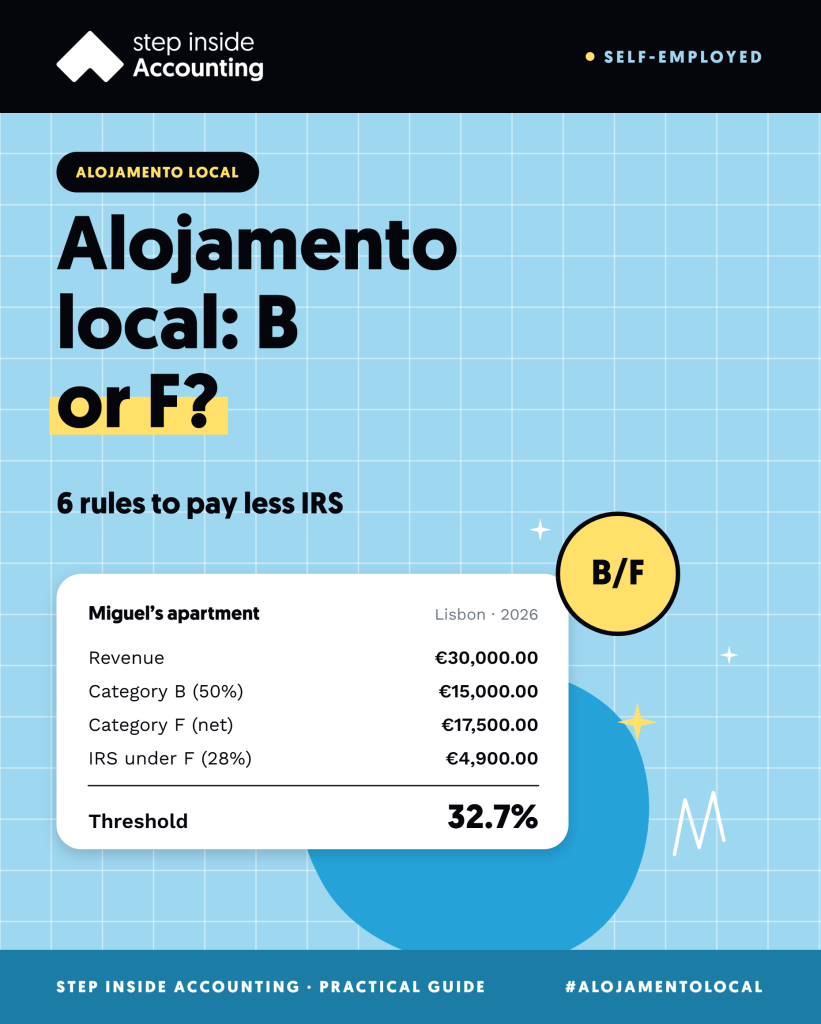
- alojamento local (short-term holiday rentals) – see our article on alojamento local;
- grants and subsidies received for the activity;
- compensation for the reduction, suspension or end of the activity;
- gains on the sale of assets used in the activity, such as equipment or a property;
- rents and interest that arise from the activity itself.
3. A one-off job is also Category B
If you do a job only once, without an open activity, the income is still Category B: it is an isolated act (ato isolado). You issue an isolated-act invoice-receipt on the Portal das Finanças and report the amount in your IRS return like any other self-employed worker. We explain when it makes sense in our article ato isolado or opening an activity.
4. What is not Category B
Some income looks like self-employment but belongs to another category:
- salaries (Category A): including when you work with hours, supervision and a workplace set by the client, even if you issue recibos verdes;
- rent from properties let without an open activity (Category F): letting an apartment on a long-term lease is not alojamento local;
- interest, dividends and copyright that are not yours originally (Category E): for example, those you receive as an heir;
- gains on the sale of personal assets (Category G): the home you live in, shares, crypto-assets held as an investment;
- pensions (Category H).
5. The category decides how much and how you pay
Knowing the category is not a detail. In Category B:
- under the simplified regime, only part of what you receive is taxed, according to the activity’s coefficient – see our article on coefficients;
- there may be withholding tax, VAT and Social Security;
- everything is reported in the same annex of the IRS return and added to your other income.
A single activity open with the Tax Authority covers all this income, as long as you have the right activity codes for each type.
Example
Sara is an illustrator who lives in Porto. In 2026 she receives:
- €30,000 for work for agencies – Category B (services);
- €4,000 in copyright for the illustrations in a book of her own – Category B (intellectual property of the author herself);
- €6,000 from a room in alojamento local – Category B;
- €9,600 in rent from an apartment let on a long-term lease – Category F;
- €1,000 in dividends from shares – Category E.
The €40,000 of Category B income all goes into the same annex of the IRS return, each with its own coefficient: 0.75 for the services, 0.95 for the copyright (with a benefit of its own) and 0.15 for the room in alojamento local. The rent and the dividends follow their own rules, with special rates or the option of adding them to your other income.
Team tip
When you start receiving a new type of income – copyright, a grant, a room in alojamento local – talk to us before you invoice. Often an activity code needs to be added, and the category changes the tax, the withholding and Social Security.
Want us to handle this for you?
Companies
Monthly accounting
Bookkeeping, tax obligations and managing partners’ salaries, all in one place.
€250 + VAT / month
Self-employed
Recibos verdes without the stress
Tax returns, VAT and Social Security handled by people who know the regime inside out.
from €80 + VAT / month
This article is for information only and does not replace professional advice. Figures and rules are those in force at the date of publication and may change.
Explore more resources
Share with someone who needs it
Want to know more? Explore the other Step Inside Accounting resources
- Blog Post
- Step Inside Accounting, Company
- Blog Post
- Step Inside Accounting, Self-Employee
- Blog Post
- Step Inside Accounting, Self-Employee