


- Blog Post
- Step Inside Accounting, Self-Employee
Social Security on recibos verdes: 5 rules to know when you start paying and how much
Step Inside Accounting · Practical guide
#StepInsideAccounting
1. You pay nothing in the first 12 months
When you open an activity as a self-employed worker for the first time, you only start contributing in the 12th month after you started. If you opened your activity in March 2026, your first contribution is the one for March 2027. During that period you pay nothing, but you also do not have the social protection of a self-employed worker. If you wish, you can ask to start earlier.
The exemption only applies the first time. If you have had an open activity before and reopen it, as a rule the obligation returns straight away.
2. The base is part of what you invoice, quarter by quarter
Contributions are not calculated on everything you invoice, but on your relevant income:
- 70% of what you invoice for services;
- 20% of what you invoice for sales of goods and for hotels and restaurants.
Every three months, you declare what you invoiced in the previous quarter. Social Security calculates the relevant income for that quarter and divides it by three: that is the monthly base for the next three months. We explain the declaration in our article on the quarterly declaration. Under organised accounting, the base is the previous year’s taxable profit.
3. The rate is 21.4%, with a €20 minimum
The 21.4% rate (25.2% for sole traders) is applied to the monthly base. There are two limits:
- if you invoiced nothing, or the calculation comes to less than €20, you pay €20 a month, unless you are exempt;
- the monthly base never exceeds 12 times the IAS, that is €6,445.56 in 2026 (the 2026 IAS is €537.13).
You pay every month, between the 10th and the 20th of the following month, using the reference from Segurança Social Direta or by direct debit.
4. You can adjust the base by 25% up or down
Each time you submit the quarterly declaration, you can ask for your relevant income to be up to 25% higher or lower, in 5% steps.
- Lowering it eases your cash flow, but reduces your protection: sickness benefit, parental benefit and your future pension are calculated on what you contribute.
- Raising it increases your protection – for example, before parental leave.
Anyone who is also employed cannot make this adjustment.
5. Know the exemptions and the main-client case
Besides the first 12 months, you may be exempt from contributing:
- if you are also employed, by different entities that are not part of the same group, with a salary of at least 1 IAS (€537.13) and average relevant income as a self-employed worker below 4 IAS (€2,148.52 a month). Above that amount, you only contribute on the excess;
- if you receive an old-age or invalidity pension and the activity can be combined with the pension.
If more than 50% of what you invoice in a year comes from a single client, that client also contributes: 7% of what it paid you, or 10% if the dependency exceeds 80%. It does not come out of your pocket, but the client should know.
Example
Ana is a designer. She opened her activity in January 2026 and starts contributing in January 2027. From January to March 2027 she invoices €6,000. In April she submits the quarterly declaration:
- relevant income for the quarter: €4,200 (70% of €6,000);
- monthly base: €1,400 (€4,200 ÷ 3);
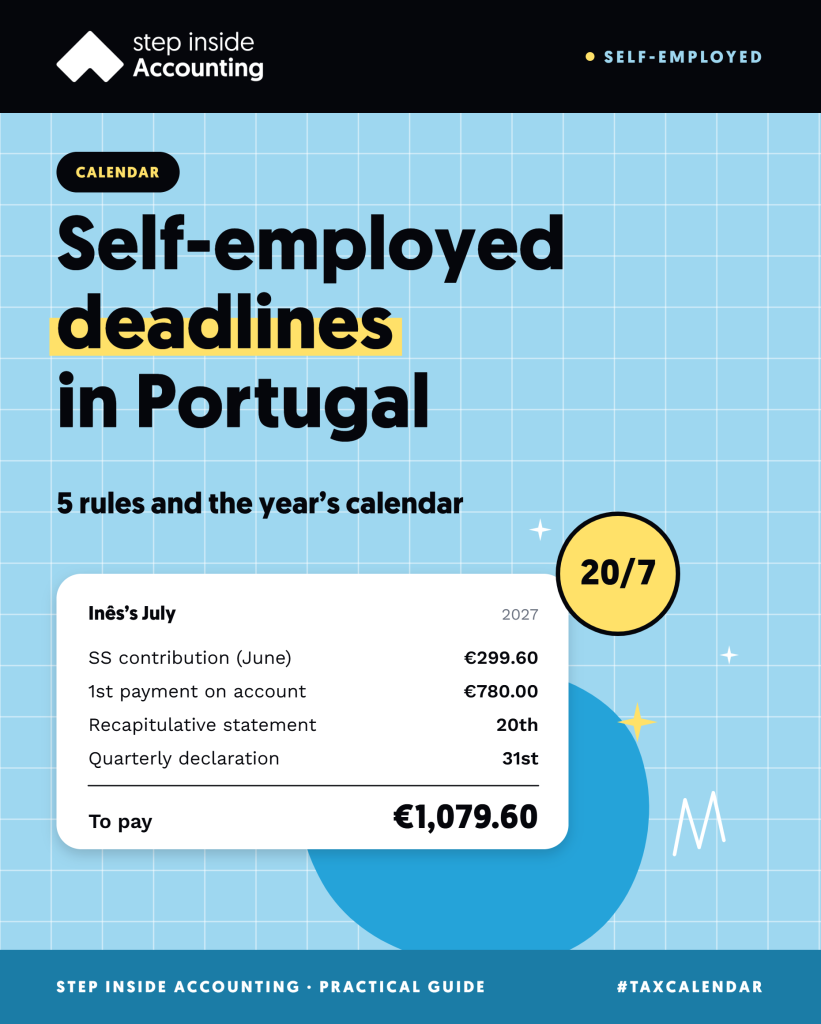
- monthly contribution: €299.60 (21.4% of €1,400).
Ana pays €299.60 for each of the months of April, May and June, by the 20th of the following month. If she asks to lower the base by 25%, the base becomes €1,050 and the contribution €224.70 a month.
Team tip
In your first year without contributions, set aside about 15% of what you invoice for services: that is roughly what you will pay when the exemption ends. That way, your first contribution will not come as a shock – and, if you are also employed, check with us that your exemption is registered.
Want us to handle this for you?
Companies
Monthly accounting
Bookkeeping, tax obligations and managing partners’ salaries, all in one place.
€250 + VAT / month
Self-employed
Recibos verdes without the stress
Tax returns, VAT and Social Security handled by people who know the regime inside out.
from €80 + VAT / month
This article is for information only and does not replace professional advice. Figures and rules are those in force at the date of publication and may change.
Explore more resources
Share with someone who needs it
Want to know more? Explore the other Step Inside Accounting resources
- Blog Post
- Step Inside Accounting, Company
- Blog Post
- Step Inside Accounting, Self-Employee
- Blog Post
- Step Inside Accounting, Self-Employee