


- Blog Post
- Step Inside Accounting, Self-Employee
Opening activity with the Tax Authority: 5 rules to start right as a self-employed worker
Step Inside Accounting · Practical guide
#StepInsideAccounting
1. Open activity before you issue your first invoice
You can only issue invoice-receipts (faturas-recibo) once your activity is open. You apply on the Portal das Finanças, under Todos os Serviços > Início de Atividade > Entregar declaração, using your NIF and password, the Chave Móvel Digital or your Citizen Card. It is free and can also be done at a tax office (serviço de Finanças) or at a Loja do Cidadão.
Before you start, have to hand:
- your NIF and access to the Portal das Finanças;
- the IBAN of the account where you will be paid;
- a clear description of the work you will do;
- a realistic estimate of what you will invoice by the end of the year.
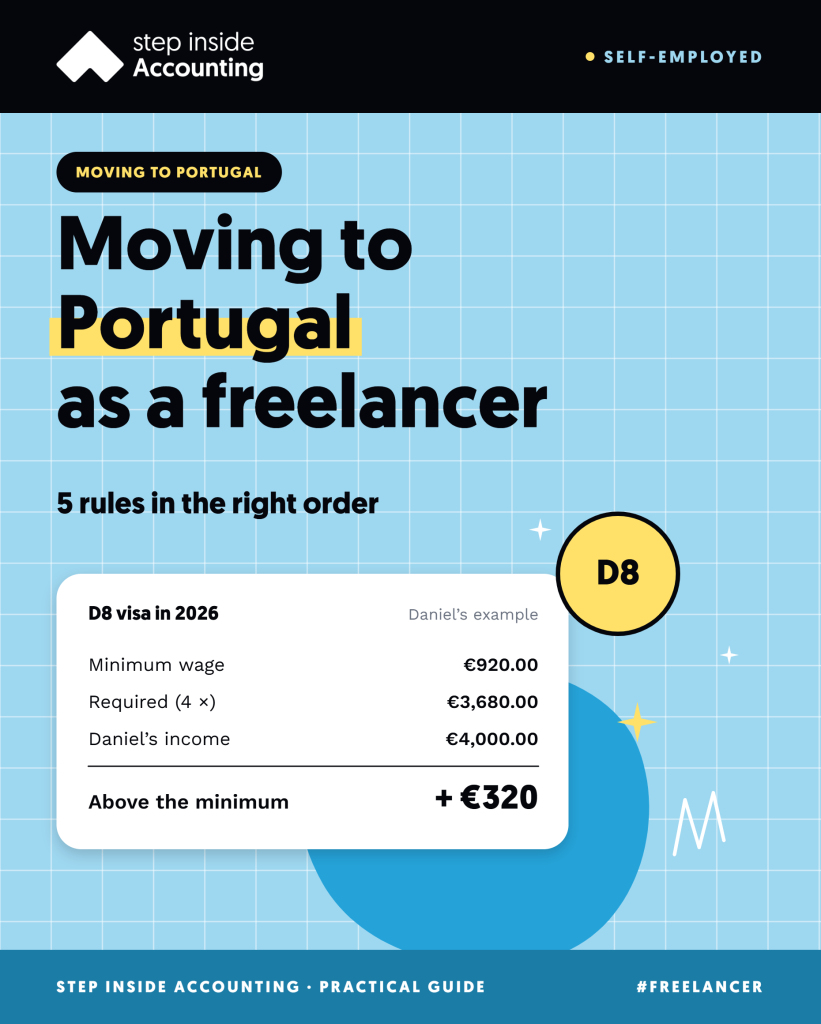
If you do not live in Portugal yet, there are extra steps before this one – we explain them in our article on freelancers moving to Portugal.
2. Choose the right code: it decides your IRS
There are two lists of codes: the IRS table of professional activities (the so-called CIRS codes, such as 1001 – Architects, 1003 – Engineers or 1332 – Computer programmers) and the Portuguese Classification of Economic Activities (CAE), used for trade and for services that are not in that table. You can choose one main code and up to four secondary ones.
The difference shows in your tax. Under the simplified regime, IRS is charged on:
- 75% of what you invoice, for activities in the CIRS table;
- 35%, for other services;
- 15%, for sales of goods.
The withholding tax rate changes too (23% versus 11.5%). Choose the code that describes what you actually do, not the one that seems to pay less: that is the one you must be able to justify if the Tax Authority asks.
3. Think carefully about your expected turnover: it decides VAT
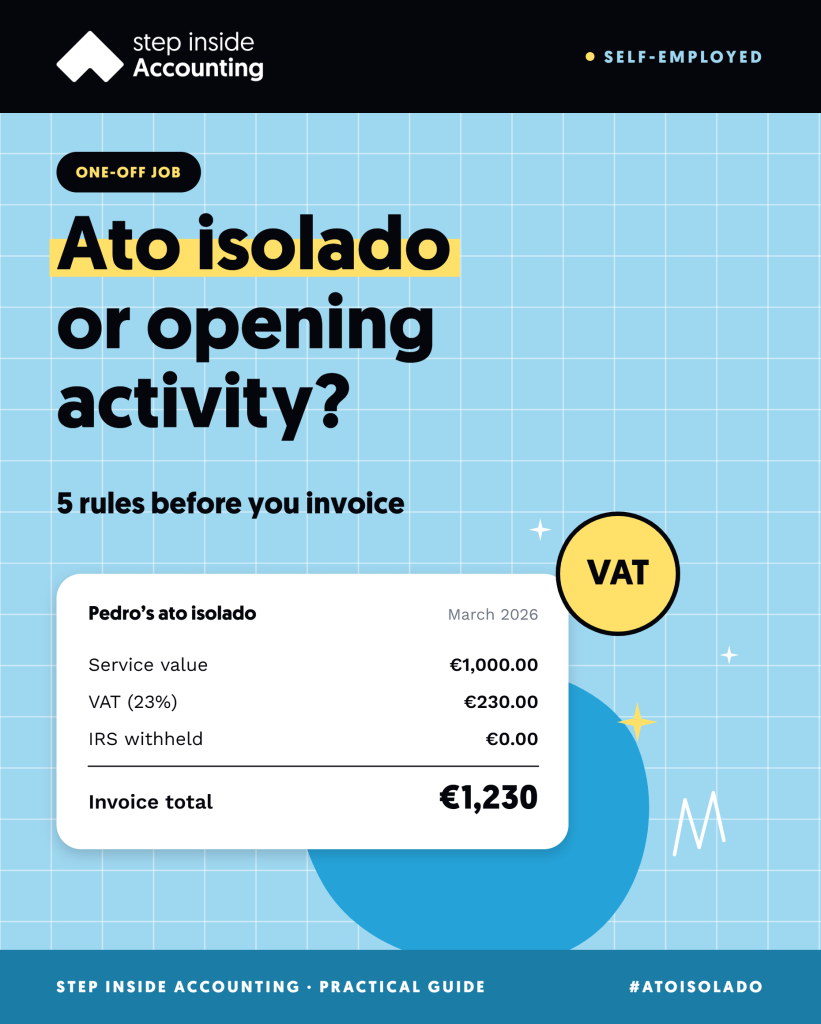
The amount you enter as expected turnover decides whether you are exempt from VAT. If you expect to invoice up to €15,000 a year in services located in Portugal – in practice, to clients based or resident here – you can be exempt and not charge VAT. If you start mid-year, the amount counts as if it were a full year: starting in July and expecting €9,000 is the same as €18,000 a year, above the limit. Some activities, such as certain health services, are VAT-exempt by their nature, whatever the amount.
The same amount sets your IRS regime: up to €200,000 you are automatically in the simplified regime. If your real expenses are high, organised accounting may pay off – we explain the differences in Simplified regime or organised accounting?
4. Understand withholding tax before you invoice
When your client has organised accounting (most companies), it withholds IRS from the value of your service and pays it to the State on your behalf. In 2026, the rates are:
- 23% for activities in the CIRS table;
- 11.5% for other services;
- 16.5% for copyright income.
If the client is a private individual, there is no withholding. If you expect to invoice less than €15,000 in the year, you can claim the withholding exemption when you issue the invoice and receive the full amount. Either way, withholding is not an extra cost: it is IRS paid in advance, deducted from your final tax in your annual return.
5. Count on Social Security and avoid the most common mistakes
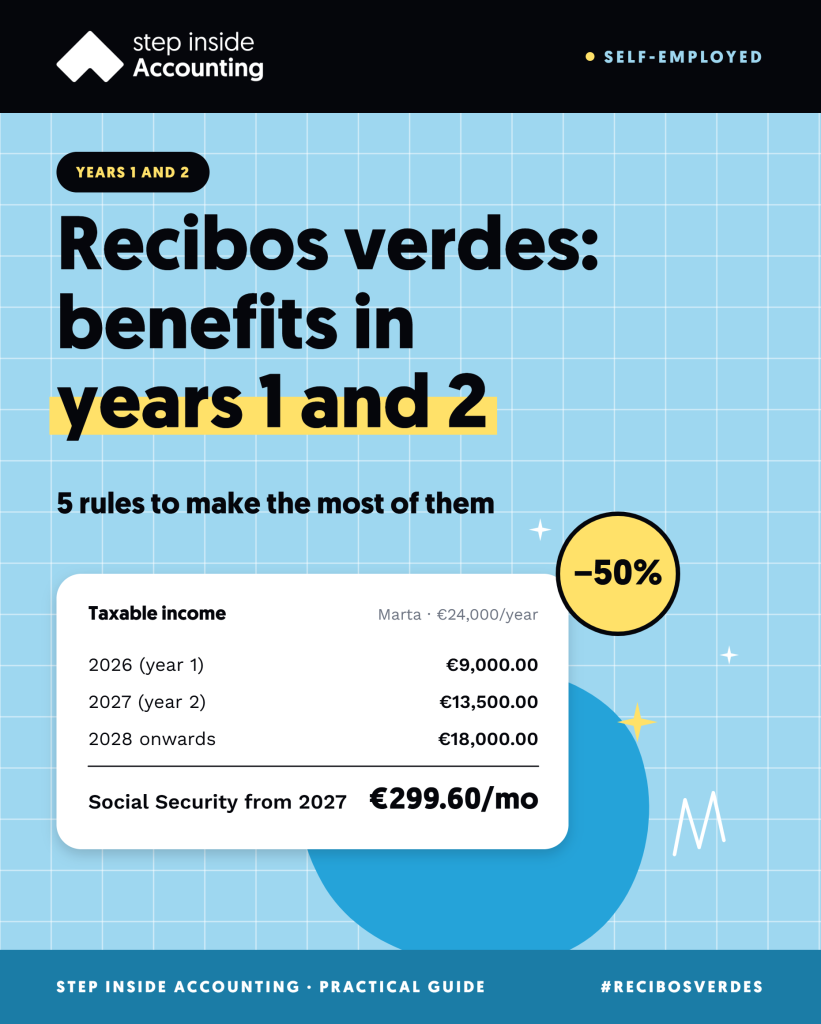
Registration with Social Security is automatic: the Tax Authority reports your start of activity and you are registered as self-employed. If it is your first activity, you are exempt from contributions for 12 months, but you still file the quarterly declaration. If you do not have a NISS yet, start with NISS in Portugal: what it is and when you need it.
The mistakes we see most often at the start:
- invoicing before opening activity;
- choosing a code that does not match the real work;
- entering a low turnover just to be VAT-exempt;
- going over €15,000 and continuing to invoice without VAT;
- not confirming expense invoices in e-fatura – see what to check before the end of the year.
Example
Inês is a programmer and opens activity in January with code 1332 (Computer programmers). She expects to invoice €30,000 to Portuguese companies, so she charges VAT from the start. On a €2,000 invoice to a client with organised accounting, in mainland Portugal:
- service value: €2,000
- VAT (23%): €460
- invoice total: €2,460
- IRS withheld by the client (23% of €2,000): − €460
- amount paid into Inês’s account: €2,000
But not all of that money is hers. Of the €2,000 she receives, €460 is VAT that she must pay to the State in her VAT return. What Inês actually keeps is €1,540 (€2,000 − €460). The €460 withheld by the client is not lost: it is an advance on her IRS and is deducted in the annual settlement.
Team tip
Before you submit your start of activity, talk to us about what you will do and who you will work for. We will confirm the code, the turnover and your VAT status with you. Getting it right before the first invoice is simple; fixing it after months of invoicing can mean change declarations and VAT paid out of your own pocket.
Want us to handle this for you?
Companies
Monthly accounting
Bookkeeping, tax obligations and managing partners’ salaries, all in one place.
€250 + VAT / month
Self-employed
Recibos verdes without the stress
Tax returns, VAT and Social Security handled by people who know the regime inside out.
from €80 + VAT / month
This article is for information only and does not replace professional advice. Figures and rules are those in force at the date of publication and may change.
Explore more resources
Share with someone who needs it
Want to know more? Explore the other Step Inside Accounting resources
- Blog Post
- Step Inside Accounting, Self-Employee
- Blog Post
- Step Inside Accounting, Self-Employee
- Blog Post
- Step Inside Accounting, Self-Employee